This week I spent a few days on the Gallipoli Peninsula in Turkey, taking my time to cycle through the battle scarred landscape. As an Australian, the site is assumed to be at the core of my national identity, and as such I thought it would be worthwhile sharing with my fellow readers this essay I wrote back at university. If you happen to have no interest in The First World War, Gallipoli, national identity, or tourism, then click on 5 Awesome Armchair Adventures to see a collection of adventurous escapades! Oh and I promise my next post will be much less serious and back to the cycling adventure (talking of which, I’m just two days from Istanbul, yippee!)
*****
Australian battlefield tourists at Gallipoli: The development of the Gallipoli Peninsula since the First World War into a popular tourist destination
With the habit of travel fast growing it seemed…likely that this interesting centre in so interesting a region would become increasingly a calling point for travellers.
C. E. W. Bean, Gallipoli Mission, 1948.
The Gallipoli Peninsula in Turkey since the First World War has developed into a popular tourist destination for Australian travellers and tourists. The landscape of Gallipoli provides an appropriate avenue through which to consider the relationship between national collective memory and identity in an era of global travel. Particular attention will therefore be given to the imaginative nature of Australian nationalism, thereby demonstrating the way in which Gallipoli itself has been transformed into an invented destination for tourist consumption. In considering the ritualised dynamics of the battlefield landscape for Australian citizens, prevailing conceptions of pilgrimage in studies of tourism will be analysed in relation to the phenomenon of nationalist journeys by Australians to Gallipoli. In utilising testimonies of Australian tourists, the relationship between such collective memories and identity to place will be considered, in which a complex range of individual motives and responses permeates throughout the battlefield experience. In addition, the role of the service occupations and industries in propagating and enabling such tourist activity will also be given due attention, situated within broader historical developments since the First World War. It will be demonstrated that the tourist industry has presented and shaped the Gallipoli Peninsula, thereby influencing both Australian participation and response to the site. The popularity of Gallipoli is therefore an interrelated phenomenon between discourses of nationalism and the development of modern tourism within the global context.

Walking upwards from ANZAC Cove
The invention of Australian national identity in the twentieth century has predominately been formulated around the myth of Anzac, with participation in international wars being collectively remembered as a narrative of nation-making and national consciousness. Particular attention therefore needs to be given to the development of the Anzac myth in Australia since the Gallipoli landings in 1915, and its dominance in imagined conceptions of nationalism. Although the conflict on the Gallipoli Peninsula ceased in 1915, the experience of the war has thereafter been consumed by collective imagination in the guise of memory. Indeed, ‘there is no escape from Anzac’ in Australian culture and society, with its myths and meanings embedded in the imagination of the nation. In this way Chris Rojek has termed such societal discourses of place as ‘an index of representation,’ in which Gallipoli has become familiar through the signs, images and symbols of the Australian culture. All tourist sites rely on distinctions which demarcate them as extraordinary places, and Gallipoli has come to constitute the material foundation of Australian identity. Although the popularity of travelling to Gallipoli cannot be solely explained by such national narratives, such discourses constitute a key component in enticing Australians to make the journey. Though there is no singular Australian identity, the profusion of Anzac mythology in Australian sense of nationalism has directly contributed to the popularisation of the Gallipoli Peninsula. The site of Gallipoli therefore originated as a place of national memory and mourning from the First World War, but subsequently developed into a popular tourist destination throughout the twentieth century. Australian nationalist discourses since the First World War therefore play a prominent role in the imagined construction of the tourist locale.
Australian battlefield tourists to Gallipoli have tended to be conceptualised by historians through the discourses of pilgrimage. Indeed, the notion of pilgrimage has even become secularised in tourist responses to Gallipoli, with Kate F. for instance describing her experience ‘like a Mecca basically, like a pilgrimage for Australians.’ The historian Brad West has coined the term ‘international civic religious pilgrimage’ to describe the ritualised experience of Australian travellers at the sacred site of Gallipoli. Such an approach has been developed through notions of civic religion, which includes the ideas, symbols, myths, values and discourses that are embodied in the conceptions of nationalism. However, although such a theoretical approach is suitable for the influence of nationalism on the development of Gallipoli, it proves anachronistic when considering individual tourists and travellers. For instance, Erik Cohen has differentiated between pilgrim-tourist and traveller-tourist, rendering the emotional relationship between the act, society and place to define the activity of travel. However, such an approach necessarily depends rather erroneously on an evaluation of the degree of purpose and compulsion of the tourist. This is wholly unattainable for the historian, reducing both the complex motivations for visiting the site and simplifying the psychology of the tourist. It is therefore sufficient here to emphasise the prominence of nationalist Anzac discourse in enabling the popular emergence of the Gallipoli Battlefields for Australian tourists.

The words of Kemal Ataturk, the ‘father’ of modern Turkey
The development of Gallipoli into a popular tourist destination has been greatly influenced by the sense of family attachment and blood ties to the peninsula. Writing on the first official ‘pilgrimage’ to Gallipoli in 1931, sponsored by what was to become the Returned Services League, John Waters described the disturbing scene of family remembrance, with ‘…the first tears that Australian mothers had shed on Gallipoli.’ The development of genealogy and family history as popular pastimes in society has also contributed to the prominence of Gallipoli for tourism. Graham Seal has noted that such personal journeys undertaken to Gallipoli can transmute the mythology of Anzac into a lived experience, transforming the site into a place of familial mourning and remembrance to reaffirm family relations. The daughter of an Australian officer who survived Gallipoli, Winsome P. retraced her father’s steps across the peninsula, and on reading ‘the names of the 13th Battalion men I wondered if they were Dad’s friend, if he were with them when they died, or were buried. I wondered at his survival and of what his memories were over the years.’ The Gallipoli Peninsula has evidently provided a place for mourning and remembrance for those personally connected to the site, and this in turn has become amalgamated with an Australian sense of nationalism to become a popular tourist destination.

Walking down to Ari Burnu Cemetery
The revival of Anzac Day and tourists to Gallipoli for the younger generation of Australians has surprised and perplexed historians. Young Australian backpackers between the ages of eighteen and thirty-five have constituted the vast majority of visitors to Gallipoli from the early 1990s, due largely to the expansion of independent international travel. In a newspaper article in 2000 Peter Bowers described Australian backpackers at the dawn service as an ‘annual migration’ to the peninsula. Significantly, most backpackers don’t travel to Gallipoli directly from Australia, but visit the site as part of their larger travel tour or as a break from living in expatriate communities such as London. Indeed, in October 2006 the current author spent time in Gallipoli as part of a six month world tour, and in the peninsula met two girls from Griffith NSW; Sarah had been living in Edinburgh, whilst her friend Amanda was on an extended Eastern European tour. Such developments need to be considered within the broader effects of globalisation, with increasing interconnections between places and the democratisation of travel.

A gravestone of a very young soldier of the war
In his extensive study of Australian travel testimonies to Gallipoli, Bruce Scates has revealed that Gallipoli accommodates both patriotism and wanderlust of young Australians, in which the experience has become in a way a rite of passage. The Gallipoli battlefield also facilitates a renewed sense of nationalism, a reaffirmation of Australian identity through the knowledge of the Anzac myth on the war setting. In this way Katie H. pointed out in an interview that Gallipoli ‘gives you something to tie yourself to while you are travelling overseas- gives you an identity of who Australians are and what has influenced our culture…it’s hard to appreciate without having travelled. The oral testimonies reveal that the sense of empathy attained by tourists on the landscape is achieved on the personal level, with young women thinking of the boys they love and journey with, whilst young men imagine mates and themselves in some shallow grave on the peninsula. Significantly, Australian travellers and tourists demarcate their time spent on the Gallipoli Peninsula with other aspects of their travels due to the reverence of the battlefield through perceptions of Anzac mythology.

A soldiers foot within his shoe!
The increasing participation of Australians to Gallipoli has subsequently been conventionally interpreted through the discourses of nationalism. In a recent article the bishop Mark Tronson argued that the younger generation of Australians are participating in a revived sense of nationalism at Gallipoli, in which they form their own nationalist traditions around Anzac. Tronson recalls his sons nationalist enthusiasm at Gallipoli, in which ‘the one item that he asked us to send him was the Australian flag…In fact, not just one Australian flag- but many flags, in different sizes and printed on various pieces of clothing, to supply him and many of his friends.’ The Gallipoli battlefield provides an occasion for enhance empathy, with visitors drawing similarities between the dead soldiers and their own lives. Moreover, the site entails nationalist solidarity, with the experience of travel engendering a collective self consciousness as it acquaints travellers with their sameness and difference. In this way Paul Connerton writes that ‘the narrative of one’s life is part of an interconnecting set of narratives…from which individuals derive their identity.’ Although the experience of Gallipoli by Australians is a prime example of Eric Leed’s contention that travel is a source of our commonality, it is important not to reduce its popularity to Australian forms of nationalist identity.
The motives of Australian tourists to visit the Gallipoli Battlefields therefore prove to be much more complex than the transformative and accommodating nature of the Anzac mythology suggests. Although the popularity of the site for Australian tourists is largely due to blood ties and the prominence of Anzac mythology, such perceptions of Gallipoli are influenced by other historical power structures, in which the individual tourist motives to travel to Gallipoli prove much more banal. The shifts in tourist motives since the First World War therefore need to be situated within the broader structural development of tourism both in Australia and the Gallipoli landscape itself. In this way Charles Bean’s prediction that the extensive appeal of the region will come to progressively accommodate the ‘habit of travel,’ needs to be substantiated through a closer consideration of the development of modern tourism. Indeed, Scates points out that the first organised tours of Gallipoli in the 1920s cost the equivalent of over a year’s wage for a skilled white male worker, whereas today it is both cheaper and more accessible due to the developments of modern tourism and globalisation. Similarly, in 1965 when the historian Kenneth Inglis accompanied the fiftieth anniversary pilgrimage to Gallipoli, he was greeted on Anzac Beach by a mere four hitchhikers, together with a small number of local village women, soldiers, officials, and media. The subsequent transformation of the peninsula into a popular tourist destination cannot be explained purely through Australian national discourses and sentiment.

A view from Gallipoli Beach
Tourism has been defined as essentially about the creation and reconstruction of geographical landscapes as distinctive tourist destinations through manipulations of history and culture. In this way tourism ‘differentiates space in a ceaseless attempt to attract and keep its market share,’ thereby striving to assert the Gallipoli peninsula as an attractive tourist destination for Australian tourists. Although the site has largely escaped the commercialisation of other tourist destinations, through its battlefield preservation it has become recreated within the tourist industry. In this way the power of the Gallipoli visit ‘derives from its participants being able to locate the Anzac legend in geographical space.’ At the Anzac dawn celebrations in 1995 Jenny N. recalled crying when the last post sounded, and ‘looking out to sea you could almost hear the sound of battle.’ Similarly, Peter Weir’s account of his 1976 trip to Gallipoli, undertaken in order to inspire the storyline of his forthcoming film, attests to the ideological connection to the location. Weir found himself ‘overwhelmed by an emotion I could only partly understand. It wasn’t only pity at the waste of it all but also a sense of discovery- it did happen, they did die, we do have a past.’ Rugged and empty, with the Aegean Sea beyond, the landscape of Gallipoli accommodates the imagination of the tourist. Cohen has highlighted that the depth of authenticity experienced by an individual traveller is a negotiable concept, dependent upon the mode of their touristic experience. The emotional response of tourists is testimony to the power of the construction of socially meaningful places, in which the most disturbing places are the battlefields most well known in Australian collective memory, such as Anzac Cove, the Nek, and Lone Pine. The interdependence between personal memory and history pervading in such tourist accounts attesting to the power of war to imagine the nation both publically and privately. In appealing to the individual Australian, the tourist experience of Gallipoli forms a significant experience of their own lives to become embedded in personal memory and identity. The role of tourism in geographically differentiating space therefore needs to be considered in light of discourses on Australian nationalism, particularly given the increasing commercialisation and commodification of the peninsula.

Lone Pine Cemetery and Memorial
The authenticity of the Gallipoli Peninsula as perceived by Australian travellers is central to the popularity of the site as a tourist destination. Although the battlefield is a site of high drama, encoded with ideology and consecrated by bloodshed, its significance has been imagined and constructed to become embodied in the tourist industry. John Urry has appropriately noted the centrality of landscape to tourist consumption, in which place signifies an experience contrasting to regularity heightening the sensual experience. The authentic function of the Gallipoli Peninsula is therefore crucial to its popularity as a tourist destination, and the landscape has become constructed into a particular aesthetic appealing to Australian sentiments. In particular, the proliferation of monuments on the peninsula is central to the aura of the site, with places of remembrance performing a crucial function of battlefield tourism. The battlefield has thus become ‘an ideologically encoded landscape through the commemorative function of the marker. As a marker inscribes war onto material soil, it becomes the sight.’ This process is particularly evident at Lone Pine, the largest Australian war cemetery overseas, where tourists now stop for a photograph. One photograph available on the internet depicts Lone Pine taken by a tourist, with the image composed using the sepia feature on their digital camera. Below the photograph another Australian has commended the ‘awesome shot. Very appropriate for the atmosphere…Great capture of such a historic location!’ The Gallipoli Peninsula has therefore been transformed into commemorative markers of remembrance, a tourist site appropriated through personal travel experiences.

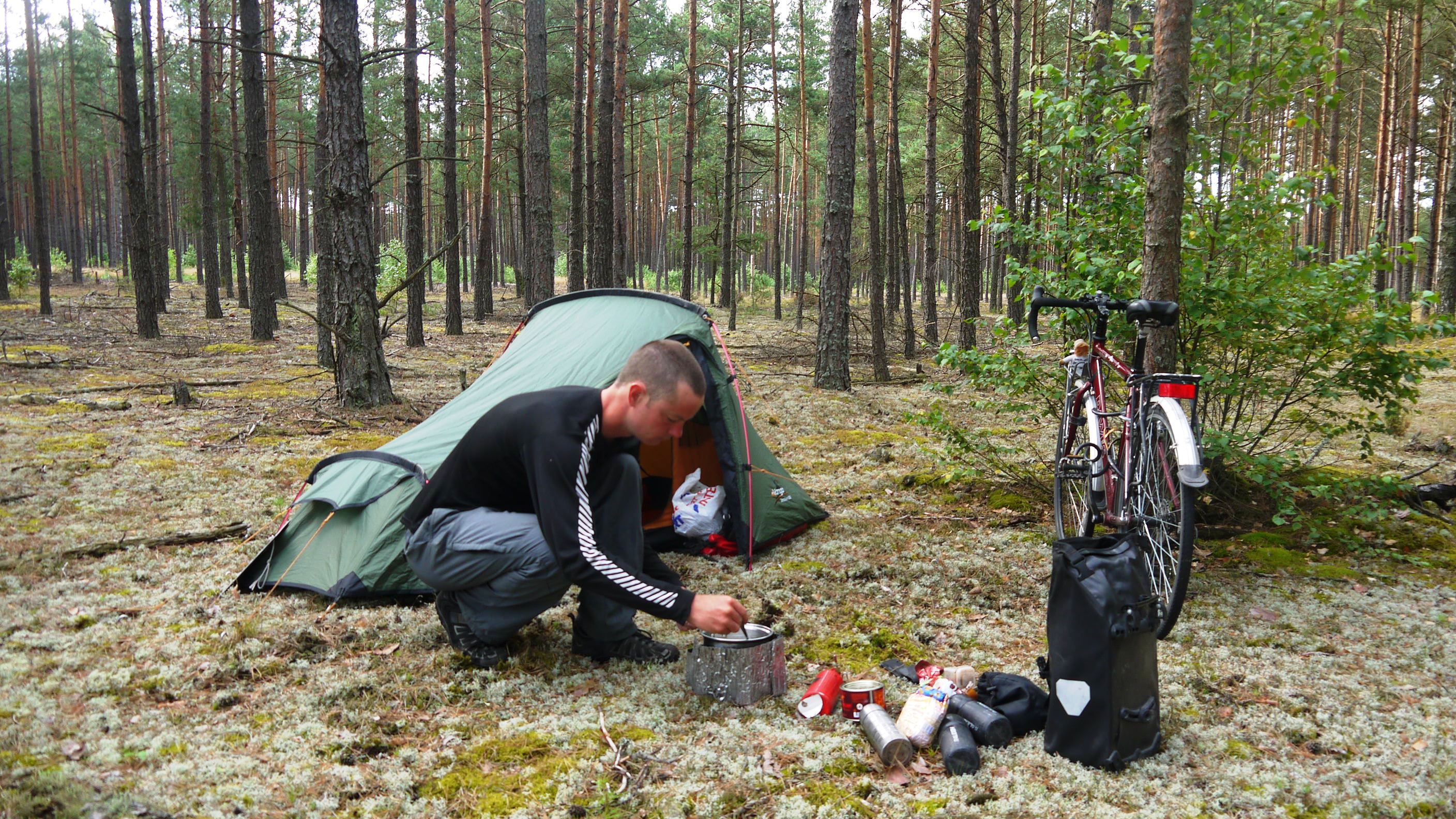
Dawn at my campsite south of the battlefield sites
In addition to the development of the Gallipoli landscape into a tourist destination, the lure of the region for tourist consumption also needs to be considered. Indeed, the symbolic appeal of the region for forging national mythology during and beyond the war has parallels with the attraction of Gallipoli as a tourist destination. For instance, Arthur Adams’ poem ‘The Trojan War, 1915’, which first appeared in the Bulletin on 20 May 1915, connects Australian involvement in the war with that of ancient Troy; ‘We care not what old Homer tells/ Of Trojan War and Helens fame:/ Upon the ancient Dardanelles/ Australia writes- in blood- her name.’ Having the heroic battlefield of ancient Troy, as well as other alluring places of interest such as Istanbul, has greatly contributed to the popularisation of Gallipoli for tourists. In this way Urry emphasises the way in which contemporary tourism is increasingly signposted, with markers identifying the things and places worthy of our gaze resulting in the concentration of tourists in limited areas. Conceived in such a way, it is evident that Gallipoli constitutes a signposted battlefield, entwined with Australian national identity and situated within a popular region of travel.
The increasing tourist infrastructure of the region has enabled Gallipoli to become more accessible and affordable for Australian tourists. Sightseeing among battlefields of war has become a lucrative branch of the international tourist trade, in which ‘…death and atrocity (are) marketable commodities.’ In this way the nationalist rituals associated with the Gallipoli peninsula are intricately linked to the forms of tourist commodification. Indeed, in 2006 the current author booked a last minute weekend tour in Istanbul of the sights of Gallipoli and Troy with Hasslefree Tours, proving both cheaper and more convenient than if it was done independently. The tour included a visit to Troy, accommodation in Canakkale, a boat cruise along the Hellespont, lunch in Eceabat, and approximately four hours touring the Gallipoli Peninsula. The role of tourist consumption in participating and experiencing Gallipoli rather than individual nationalist sentiment therefore needs to be emphasised. In the process of commercialising the past ‘history has become commodified, an experience purchased with an air ticket.’ Such commoditisation of the past for tourist purposes, particularly through destination marketing, has had a profound impact on popularising Gallipoli for Australian tourists.
The expansive information network of modern society has also had an immense impact in making the Gallipoli Battlefield a popular tourist destination for Australians. In particular, the proliferation of tourist guidebooks such as Lonely Planet has allowed independent travel to Gallipoli to become much easier. Such guidebooks provide information on getting to the peninsula, recommend accommodation, supply maps, advise on particular sites, and itinerise the battlefield for tourist consumption. Moreover, the increasing tourist information available on the internet has also made necessary travel information more accessible for aspiring Australian battlefield tourists. In addition, in her study of the social interactions of backpackers, Laurie Murphy has highlighted the way in which the exchange of information between travellers by word-of-mouth results in the promotion of particular destinations.

Sunset at the New Zealand Memorial
The role of mass communication media has also rendered the annual 25 April Dawn Service into a media extravaganza, and a must do for young travellers from Australia. Indeed, Turkish authorities have already begun planning for the centenary celebrations, in which visitor numbers will be restricted due to concerns over the ability of the Gallipoli landscape to accommodate the large number of people expected. It is apparent that contemporary societies are obsessed with remembering, with the past propagated throughout Australian popular culture. Indeed, Peter Weirs 1981 film Gallipoli has played a fundamental role in popularising the tourist destination. It is evident that there is a circular process by which the testimonies of individual experiences of Gallipoli, extenuated by media attention and tourist destination marketing, popularises the idea of personally experiencing the Gallipoli Peninsula. This suggests that the phenomenon of Australians travelling to Gallipoli has become fashionable through its proliferation in popular culture, rendering the site into an attractive tourist destination.
This essay has deconstructed the various factors contributing to the popularisation of the Gallipoli Battlefield for Australian tourists since the First World War. The national identity of Australia has become bound up with the Gallipoli Peninsula, and is suffused with memories, myths and meanings. However, evidence suggests that tourist motivations for visiting the site prove much more complex than the prevailing nationalist discourses allow, suggesting that its resurgence in popularity is due to more banal reasons. Nevertheless, the landscape remains a popular site to perform nationalist rituals associated with remembrance, and has thereby had a profound role in formulating in Australian nationalist identity. Moreover, visiting Gallipoli provides an avenue through which to personally experience perceptions of the past, and its general appeal can therefore be largely explained by its ability to become appropriated in individual memory and identity. The development of modern tourism in global society has had a profound influence on restructuring the destination for Australians, employing the nationalist appeal of Gallipoli to incorporate the site into the tourist network. In this way it can be supposed that Australian tourists have essentially succeeded where its invading soldiers had failed in 1915. The First World War evidently popularised Gallipoli, subsequently becoming developed into a popular tourist destination for Australian consumption.

A moment of reflection at ANZAC Cove